Finding CVE-2020-3580 on Nokia's Cisco ASA web portals
How an exposed Cisco ASA WebVPN portal led to a reflected XSS finding during an authorized Nokia assessment.
The finding
During an authorized review of Nokia-owned assets, I found Cisco ASA WebVPN portals exposed on several in-scope subdomains. The portals were not unusual by themselves; internet-facing VPN interfaces are expected to receive constant probing, so I focused on how the portal handled inputs in its authentication and federation flows.
That review led to CVE-2020-3580, a cross-site scripting issue affecting Cisco ASA WebVPN. The important part was not simply that a string was reflected. The application accepted attacker-controlled data, placed it into an HTML response, and failed to encode it for the context where it was used. A browser could therefore interpret the data as markup or script instead of displaying it as text.
The affected hostnames and any identifying values are redacted here. The original report was submitted to Nokia through its responsible-disclosure process.
Starting with the attack surface
I began with passive discovery rather than sending requests to every hostname I could find. The goal was to build a list of assets that were both publicly visible and covered by the program scope.
subfinder -d nokia.com -silent -o nokia-subdomains.txt
amass enum -passive -d nokia.com -o nokia-amass.txt
cat nokia-subdomains.txt nokia-amass.txt | sort -u > nokia-hosts.txt
httpx -l nokia-hosts.txt -status-code -title -tech-detect -o live-hosts.txt
The output was useful for triage, not proof. I removed duplicates, reviewed the live responses, and looked for hosts whose titles, paths, or response structure suggested a Cisco ASA WebVPN portal. Once I had a short list, I switched from broad discovery to careful manual testing.
That distinction matters. A technology fingerprint can be wrong, and a scanner finding does not establish a vulnerability. The interesting question was how the portal processed values that crossed from a request into the returned page.
Following the SAML flow
The relevant endpoint was the SAML assertion consumer service:
/+CSCOE+/saml/sp/acs?tgname=a
This endpoint receives the identity provider’s assertion through the SAMLResponse parameter. In a normal login, that value contains a signed or encoded response generated by the identity provider. I was not trying to forge an assertion or log in as another user. I was testing whether the portal treated data inside the request as data or as page content.
I started by sending a benign, uniquely identifiable marker and comparing the response with the request. The marker appeared in the returned WebVPN page. I then changed the marker to a harmless proof-of-execution test, using a redacted test value in the public version of this article.
The sanitized request looked like this:
POST /+CSCOE+/saml/sp/acs?tgname=a HTTP/1.1
Host: [redacted].nokia.com
Content-Type: application/x-www-form-urlencoded

SAMLResponse=[redacted harmless XSS test marker]
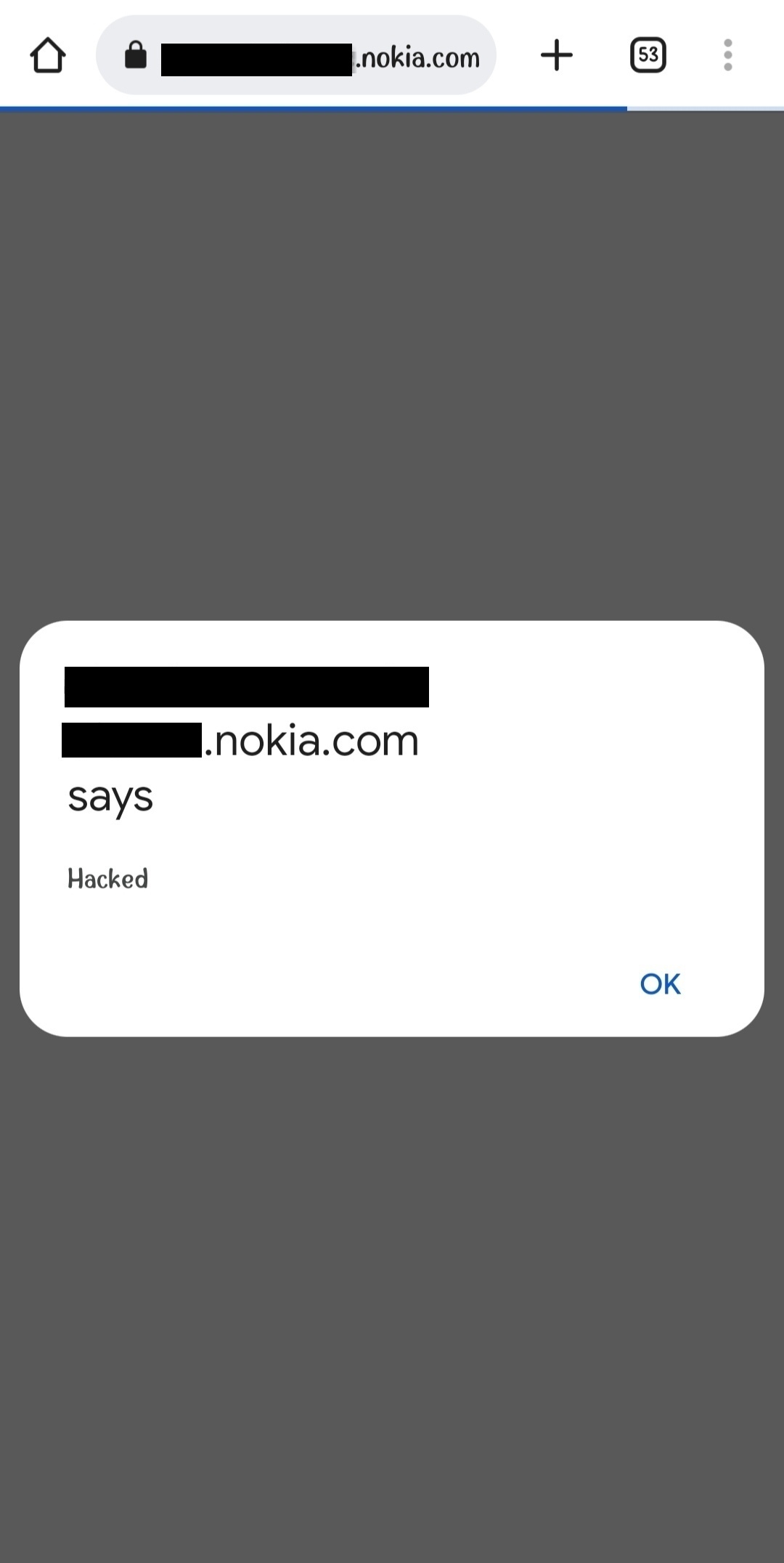
The response caused the browser to interpret the value in an executable HTML context. That confirmed the security boundary had been crossed: the input was no longer being treated as an inert SAML value or escaped text.
Root cause
The root cause was context-insensitive handling of attacker-controlled input in the WebVPN SAML response flow. The application accepted a value from the request and inserted it into the generated HTML without applying the output encoding required for that context.
There are two separate protections involved here:
- Input validation can reject malformed values that do not belong in a SAML response.
- Context-aware output encoding ensures that even unexpected data is displayed as text when it reaches HTML, an attribute, JavaScript, or another output context.
Validation alone is not a substitute for encoding. A value that passes a loose allowlist can still become markup if it is later inserted into a page incorrectly. In this case, the reflected response behavior showed that the output path was the important failure.
What I verified—and what I did not
I limited the verification to the minimum needed to demonstrate the issue:
- The request was sent only to assets covered by the disclosure scope.
- The test used a harmless marker and a controlled proof of execution.
- Hostnames and identifying values were redacted from the public evidence.
- I did not access accounts, read SAML assertions, steal sessions, or test other users.
- I stopped after confirming the browser-side execution behavior.
This produced a reproducible report without turning a proof of concept into an attempt to compromise the VPN service.
Impact
Successful exploitation could allow JavaScript to run in a victim’s browser under the WebVPN origin. The exact impact depends on the portal configuration and the victim’s state, but an attacker could potentially target users who visit a crafted link or submit a crafted authentication flow.
The risk is higher for a security-sensitive interface such as a VPN portal because users may already be authenticated, may trust the origin, and may expect the page to handle identity-provider data. I did not attempt to demonstrate session theft or account access; those actions were unnecessary to establish the vulnerability.
Reporting and recognition
I reported the affected Nokia assets with:
- the affected endpoint and request method;
- a sanitized reproduction;
- the observed reflection and execution behavior;
- an impact explanation;
- redacted screenshots and hostnames.
Nokia acknowledged the report through its responsible-disclosure process. The work was later recognized in Nokia’s security Hall of Fame.
Lessons from the investigation
- Start with passive discovery and confirm scope before testing.
- Treat scanner output as a lead, not a conclusion.
- Follow data through the application instead of stopping at a technology fingerprint.
- For XSS, identify the exact output context and whether encoding is applied there.
- Use the smallest safe proof that demonstrates execution.
- Redact hostnames, tokens, and customer information before publishing evidence.
- Stop testing once the report is reproducible and the impact is clear.